
Legal Marijuana States: A Guide to Where Cannabis Is Legal
Explore the list of legal marijuana states where recreational cannabis is allowed. This guide explains which U.S. states have legalized adult-use marijuana, how federal vs. state laws differ, and what this means for residents.
The term legal marijuana states refers to U.S. states that have legalized the possession and sale of cannabis for adult recreational use. As of 2025, only 24 states (plus Washington, D.C.) have legalized recreational marijuana. In these jurisdictions, adults 21 and older can legally buy and possess cannabis within specified limits.
This guide lists those states, outlines the history of legalization, explains the legal context, and answers common questions.
Which States Have Legalized Recreational Marijuana?
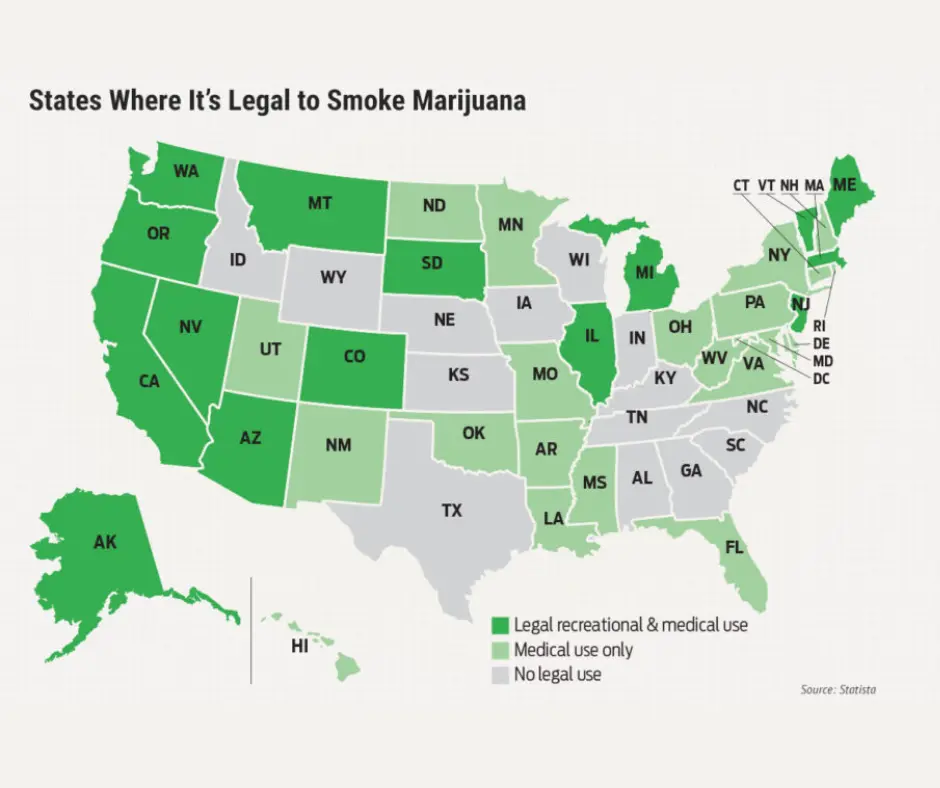
Below is a list of U.S. states (and D.C.) that allow recreational marijuana for adults:
Alaska – Legal since 2014. Adults 21+ can possess up to 1 oz and grow up to 6 plants (3 mature).
Arizona – Legal since 2020. Adults 21+ can possess 1 oz and grow up to 6 plants.
California – Legal since 2016. Adults 21+ can possess 1 oz and grow up to 6 plants (with limits on sales).
Colorado – Legal since 2012iihs.org. Adults 21+ can possess 1 oz and grow up to 6 plants (3 mature).
Connecticut – Legal since 2021. Adults 21+ can possess 1.5 oz and grow up to 6 plants.
Delaware – Legal since 2023. Adults 21+ can possess up to 1 oz and grow plants (details by state law).
District of Columbia – Legal (Initiative 71, 2014). Adults 21+ can possess 2 oz and grow up to 6 plants (3 mature).
Illinois – Legal since 2019. Adults 21+ can possess 1 oz and grow up to 5 plants.
Maine – Legal since 2016. Adults 21+ can possess 2.5 oz and grow up to 15 plants (3 mature).
Maryland – Legal since 2023. Adults 21+ can possess up to 1.5 oz and grow plants (details in state law).
Massachusetts – Legal since 2016. Adults 21+ can possess 1 oz and grow up to 6 plants.
Michigan – Legal since 2018. Adults 21+ can possess 2.5 oz and grow up to 12 plants.
Minnesota – Legal since 2023. Adults 21+ can possess 2 oz in public and 2 lbs at home, with 8 plants allowed.
Missouri – Legal since 2022. Adults 21+ can possess 3 oz and grow up to 6 flowering plants.
Montana – Legal since 2020. Adults 21+ can possess 1 oz and grow up to 4 mature plants.
Nevada – Legal since 2016. Adults 21+ can possess 1 oz and grow up to 6 plants.
New Jersey – Legal since 2020. Adults 21+ can possess 1 oz.
New Mexico – Legal since 2021. Adults 21+ can possess 2 oz and grow up to 6 plants (12 per household).
New York – Legal since 2021. Adults 21+ can possess 3 oz and grow up to 12 plants.
Ohio – Legal since 2023. Adults 21+ can possess up to 2.5 oz and grow up to 6 plants.
Oregon – Legal since 2014. Adults 21+ can possess 1 oz in public (8 oz at home) and grow up to 4 plants.
Rhode Island – Legal since 2022. Adults 21+ can possess 1 oz in public (10 oz at home) and grow up to 6 plants.
Vermont – Legal since 2018 (effective 2022). Adults 21+ can possess 1 oz and grow up to 6 plants.
Virginia – Legal since 2021. Adults 21+ can possess 1 oz and grow up to 4 plants. (Legal sales started in 2024.)
Washington – Legal since 2012 iihs.org. Adults 21+ can possess 1 oz and grow up to 6 plants (no limit on concentrates).
Each state’s law includes specific regulations on possession limits, home cultivation, purchase locations, and licensing. For example, many states limit purchases to one ounce at a time, and some cap how many plants can be grown at home.
For more on state laws and cannabis regulations, see the US LawPulse Laws category for updates and legal guides.
Timeline of Marijuana Legalization in the U.S.
The path to legalization has been gradual. Key milestones include:
2012: Colorado and Washington legalized recreational marijuana via ballot initiatives iihs.org, becoming the first U.S. states to do so (retail sales began in 2014).
2014: Oregon and Alaska legalized recreational cannabis (votes in 2014; sales started in 2015). Washington D.C. passed Initiative 71, allowing possession (sales are still restricted).
2016: Four more states legalized by ballot measures: California, Maine, Massachusetts, and Nevada.
2018: Michigan legalized recreational marijuana by voter initiative. (Vermont’s legislature approved legalization, effective 2022.)
2019: Illinois legalized adult-use cannabis by legislative action.
2020: Three states – New Jersey, Montana, and Arizona – voted to legalize recreational use. (South Dakota had also voted yes, but courts nullified that law.)
2021: New York, New Mexico and Virginia legalized recreational marijuana through legislation.
2022: Connecticut and Rhode Island legalized recreational cannabis via legislative action. Missouri’s voters approved legalization in late 2022.
2023: Delaware and Maryland passed legalization laws. Minnesota and Ohio voters approved recreational marijuana initiatives in November 2023, bringing the total to 24 states plus D.C.
This history reflects growing public support: polls show over two-thirds of Americans back full legalization mpp.org. With each new law, more states join the list of legal marijuana states.
Federal Law vs State Law
It’s important to note that while these states have legalized cannabis, marijuana remains illegal under federal law. The U.S. Drug Enforcement Administration (DEA) classifies marijuana as a Schedule I controlled substance (the highest restriction level, shared with heroin and LSD).
This means, federally, cannabis is considered to have no accepted medical use and a high potential for abuse. As a result, activities legal under state law (like selling in a dispensary) are still technically federal crimes.
Congress has debated changing this status. For instance, the “Marijuana 1-to-3 Act of 2023” (H.R. 610) is a proposed federal bill to reclassify marijuana from Schedule I to Schedule III, which would acknowledge medical use and lower penalties.
However, as of now no federal law change has been enacted, so all marijuana remains illegal under federal law (the DEA’s official Drug Scheduling page still lists cannabis as Schedule I).
This federal-state conflict leads to practical issues:
Banking and Finance: Cannabis businesses in legal states often struggle to use banks, since banks regulated federally avoid drug businesses. This forces many to operate on cash, raising safety and accounting challenges.
Travel: Possession or transport of marijuana across state lines (or international borders) is illegal. Even between legal states, crossing state lines is a federal offense.
Regulations: Federal law still prohibits marijuana advertising across state lines and Interstate commerce of cannabis. States must regulate and license production and sale entirely within their borders.
Despite federal prohibition, states have crafted detailed regulatory systems for legal marijuana states, setting age limits (usually 21+), purchase and possession limits, licensing for growers and retailers, and rules on public use. Consumers should familiarize themselves with local laws before using cannabis (for example, many states only allow on-premises consumption or private use, not public smoking).
Recreational vs Medical Marijuana Laws
Most U.S. states differentiate between recreational (adult-use) and medical cannabis. Currently, 39 states (and D.C.) have laws allowing medical marijuana for qualifying patients.
The list above covers recreational legalization. States not on the recreational list may still have medical programs or decriminalization. For example, Texas has limited medical cannabis, and many states impose only fines (decriminalization) for small amounts.
Always check state law via official sources or trusted legal guides (see US LawPulse).
[sp_easyaccordion id=”4016″]


Leave a Comment